 White Tank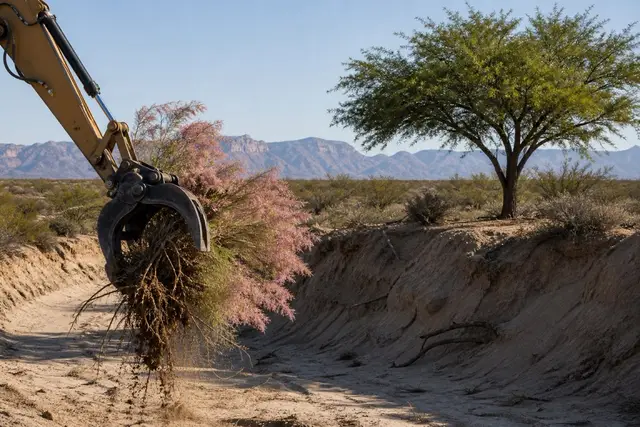
White Tank Clearing Pros puts Buckeye property owners on the phone with a local land clearing contractor when the job is salt cedar & invasive removal — in Buckeye proper and the desert communities around it.
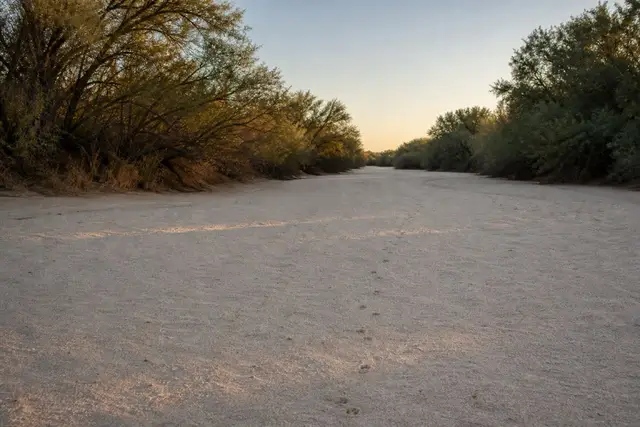
Salt cedar — tamarisk, if you knew it back east — is the invader with the best real estate in Buckeye: the Hassayampa corridor, the Gila's old meanders, every irrigation tailwater and wet-footed wash on the map. It drinks prodigiously, salts the surface soil beneath itself until natives give up, packs into thickets that swallow fence lines, and burns like it was designed for it. A parcel with established tamarisk isn't overgrown; it's occupied.
Removal is a roots-first proposition, and this is where casual attempts fail. Cut salt cedar resprouts from the root crown almost gleefully — a chainsaw pass turns one trunk into a hydra by next summer. Getting rid of it means the excavator grubs each crown out whole, sandy soil shaken back into the hole, and the debris hauled or chipped rather than left to re-root in damp ground. On heavy infestations, a follow-up check the next season catches the stragglers while they're still hand-pullable.
The same visit typically handles the rest of the invader roster. Russian thistle — tumbleweed — gets mowed and hauled before it dries, breaks loose, and stacks itself against your fences. Buffelgrass and fountain grass, escaped ornamentals turning Arizona roadsides into fuel beds, get grubbed or sprayed while their patches are still small. None of it has the legal protections native plants carry, so the work moves fast once it starts.
What stays is the point: mesquite bosque along the wash banks, wolfberry and saltbush that belong there, and every saguaro anywhere near the work — flagged, given room, untouched. Invasive removal done right doesn't leave a bare scar; it leaves the native desert with its water table and root zone back.
Know the enemy: what tamarisk does to a wash
The federal invasive-species program keeps a clear rap sheet on saltcedar: aggressive colonization of riparian corridors, heavy water draw, surface soil salinization, and displacement of the cottonwood-willow and mesquite communities that native wildlife actually uses. On your parcel that translates concretely — ground under a tamarisk thicket grows little else, the thicket itself is a fire ladder in a wash that funnels wind, and the root crowns knit into bank soil so thoroughly that flood flows undercut around them in odd, destructive ways.
Buckeye sits on a living example of what the alternative looks like: the Hassayampa River Preserve upstream protects one of the state's surviving native riparian reaches, all cottonwood galleries and year-round water. Nobody expects a ranchette wash to become a preserve, but the direction of the work is the same: take the invader's roots out, and the natives that evolved for this hydrology take the ground back.
Sequence and season: how the removal actually runs
Salt cedar work rewards planning around water and weather. Dry season is digging season — crowns come out of a dry wash bed cleanly, machines don't rut saturated sand, and there's no storm flow to carry cut material downstream to found a new colony. Once the monsoon pattern sets up, typically mid-June into September by the Phoenix NWS office's reckoning, work in active washes gets scheduled between disturbances and staged out of the flow line — a flash flood does not care that your equipment was almost done.
The sequence itself: grub crowns, sort debris (tamarisk never gets left in contact with damp soil), restore the bank profile so the next flow doesn't exploit the excavation, then walk the reach the following season for resprouts. On parcels where herbicide follow-up makes sense for stragglers, cut-stump treatment is the targeted approach — the UA Cooperative Extension publishes the standard guidance, and spot treatment beats broadcast spraying in every way that matters next to a wash.