 White Tank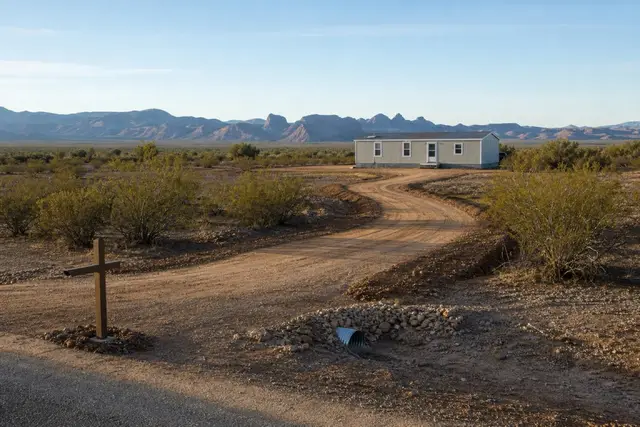
White Tank Clearing Pros puts Buckeye property owners on the phone with a local land clearing contractor when the job is access road & driveway clearing — in Buckeye proper and the desert communities around it.
Every parcel sold along Sun Valley Parkway, out toward Tonopah, or up the Wittmann-Morristown corridor comes with the same unlisted first project: getting onto it. Access road clearing turns a line on the plat into a drivable route — brush corridor cleared, alignment picked around the trouble the ground offers, surface bladed, and the whole thing shaped so the first summer storm doesn't repossess it.
Alignment is where money is saved or buried. The straight line to the building site might cross a wash twice, thread a saguaro cluster that isn't going anywhere, or cut against the grain of the parcel's drainage. A better alignment follows the ground's logic — crossing washes at their widest, shallowest points, keeping grade gentle, letting the road shed water continuously instead of collecting it. An hour of layout with flags beats a decade of fighting a badly placed drive.
The surface itself is desert-simple and technique-dependent. Native material bladed to a crown sheds rain to both sides; without the crown, the road becomes the channel, and one storm cuts a rut you'll straddle for years. Where the route crosses drainage, the choice is an armored dip — cheap and honest for occasional flow — or a properly sized culvert bedded and covered so it neither floats nor crushes. Both work; pretending the wash isn't there does not.
Clearing width follows use: a single-lane ranch drive needs a modest corridor, while a route that will someday carry a well rig, concrete trucks, and a manufactured-home toter needs width, turning radius, and a firmer surface at the entrance apron. Cheapest time to build for the big vehicle is before it's scheduled.
Washes: where desert roads live or die
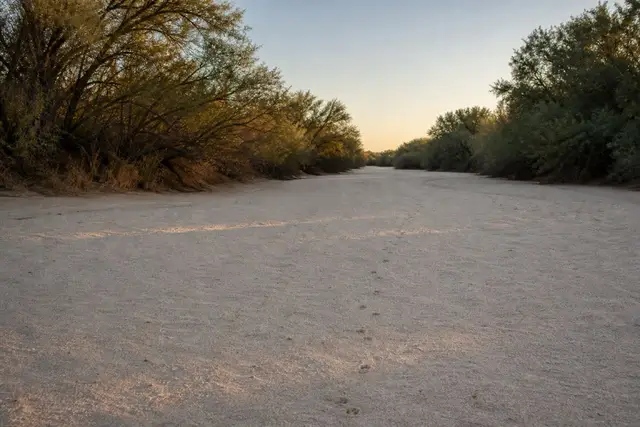
Dry nine-tenths of the year, the washes crossing Buckeye acreage move genuinely dangerous water when a cell parks over their catchment — the NWS flash-flood guidance is emphatic that most flood deaths happen at low-water crossings, and the same physics applies to your driveway. Building a crossing right means respecting the flow the channel is sized for: dips armored with rock so flow passes over a hardened surface, culverts sized for the catchment rather than the pipe that was on sale, and approaches graded so water can't outflank the structure.
Geology sets the constraints underneath. Bajada soils near the White Tanks carry buried cobble and sheet caliche that change excavation effort within a hundred feet; the Arizona Geological Survey's mapping is a surprisingly practical read for acreage owners wondering why the neighbor's road cost half what theirs did. Test the alignment before committing the blade.
Dust, neighbors, and the long life of a dirt road
A new dirt road is a dust source with a schedule — every vehicle pass lifts fines until the surface either compacts into a stable crust or gets stabilized. During construction, once more than a tenth-acre of ground is opened, the work falls under Maricopa County's dust-control rules; after construction, a road built from well-graded native material, crowned and compacted, settles into a hard-wearing surface that generates a fraction of the dust loose blading leaves behind. Gravel topping the high-traffic sections near the house is the common upgrade, and cheap while the equipment is already there.
Maintenance is a light touch if the bones are right: a blade pass after the monsoon season to restore the crown, rock replenished in the dips, and vegetation mowed back before it crowds the corridor. Owners who skip the fall blade pass buy the spring rebuild — the Extension's rural-property resources make the same point about every piece of desert infrastructure: small scheduled care or large unscheduled repair, pick one.