 White Tank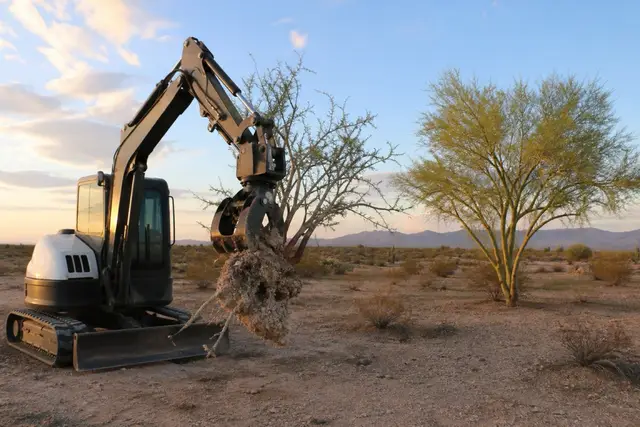
White Tank Clearing Pros puts Buckeye property owners on the phone with a local land clearing contractor when the job is mesquite & palo verde removal — in Buckeye proper and the desert communities around it.
Velvet mesquite is Buckeye's great opportunist. Give it a fence line, a wash bank, an irrigation leak, or five undisturbed years, and a single feathery volunteer becomes a multi-trunk thicket with two-inch thorns and a root system engineered for drought. Palo verde seeds in nearly as fast wherever ground gets scratched. Removal is a different job from pruning: the point is deciding which trees serve the property and taking the rest out in a way that actually ends them.
The ending part is the craft. Cut a mesquite flush at the dirt and you've scheduled its return — the buried crown pushes a ring of whip-straight shoots within a season, and the second thicket is worse than the first. Real removal means the excavator takes the crown and primary roots out whole, dirt shaken off, hole closed. It costs more than a chainsaw hour and it is the only version worth paying for.
Selectivity is the other half. A mature mesquite in the right spot is thirty degrees of shade in July and habitat besides; a native palo verde is the state tree and, in bloom, the best-looking thing on the parcel. Good removal work reads like editing, not demolition — thin the volunteers, open the sight lines, keep the specimens. Every saguaro stays, automatically, and protected natives slated for removal get handled through the state's notice process, not quietly bladed out.
Debris has options in this valley: chip the brush where it fell, grapple-load the trunks for haul-off, or buck the clean mesquite into rounds — high-desert firewood good enough that some owners ask to keep the pile. What doesn't happen is burning next to Buckeye's new rooftops.
Access matters to the bid: a front-yard specimen with trailer parking prices differently than eleven volunteers scattered across a back five with one gate. The walk-through sorts that out, and the number that follows is written and itemized.
The paperwork a protected tree carries
Arizona's native plant framework surprises newcomers: the plants belong to you, but destroying certain species on your own land still requires notifying the state in advance. Ironwood and saguaro sit in the most protected tiers; native mesquite and palo verde appear in the law's harvest-restricted categories as well. The University of Arizona Extension's summary of the Native Plant Law lays out the categories and the notice clock — filed weeks ahead, with the state given a window to arrange salvage of plants worth moving.
For a typical Buckeye removal job the practical effect is modest: volunteers under the size thresholds clear quickly, the notice gets filed where it applies, and salvageable specimens — young saguaros especially — get offered for relocation rather than destroyed. An operator who shrugs at this process is offering you liability, not efficiency; the fines land on landowner and contractor alike.
Roots, caliche, and why the hole matters
Mesquite roots in this soil do two things that shape the work. They chase moisture deep — through sandy loam and into fractured caliche — and they anchor a crown that regenerates from buds below any cut you can make with a saw. Grubbing works because it removes that bud zone entirely. Where the crown sits socketed in cemented hardpan, the excavator ends up breaking caliche to free it; the UA Extension's caliche guide explains why that layer behaves like buried concrete and what it takes to get through it.
The hole left behind deserves attention too. A grubbed cavity backfilled loose becomes a settling pit under next summer's storms — the Phoenix NWS office counts on a handful of serious monsoon soakings a year even in a seven-inch rainfall climate — so proper work compacts the backfill in lifts and crowns it slightly. Small detail, but it's the difference between a finished job and a callback.