 White Tank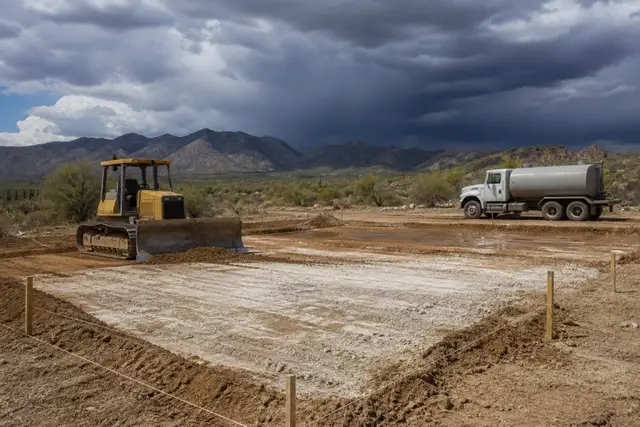
White Tank Clearing Pros puts Buckeye property owners on the phone with a local land clearing contractor when the job is grading & site prep — in Buckeye proper and the desert communities around it.
Grading is where a Buckeye parcel stops being desert and starts being a site. After clearing and grubbing, the dozer and blade establish the elevations everything else inherits: a pad cut level and compacted for the slab, swales pitched so monsoon water leaves instead of ponding, a building envelope that sits proud of the ground around it. Get this layer right and the foundation crew, the flatwork crew, and the landscaper all have easy days. Get it wrong and every trade after pays for it.
The far West Valley's dirt keeps graders honest. The sandy loams cut beautifully right up until the blade finds caliche — cemented carbonate hardpan that can sit anywhere from inches to several feet down and varies across a single lot. Shallow caliche means ripping or breaking before the cut can continue; it also means water from a summer storm perches on the hardpan instead of soaking away. A grading plan that pretends the ground is uniform is a change order waiting to be issued.
Water design is the quiet half of the job. Buckeye averages only around seven or eight inches of rain a year, but it arrives with attitude — an inch in an hour off a monsoon cell is normal, and flat ground turns into sheet flow with nowhere assigned to go. Proper site prep gives it an assignment: positive drainage off the pad in all directions, swales that collect and carry to the natural discharge point, and rough grade shaped so the finished landscape doesn't fight the hydrology.
Compaction closes the loop. Fill placed under anything structural goes down in measured lifts, moisture-conditioned and compacted to spec, because loose-dumped fill settles and takes slabs with it. On jobs where the engineer wants density numbers, testing happens lift by lift; on simpler residential pads, the standard is still compacted-in-lifts — just without the lab paperwork.
Dust control runs through all of it: grading is soil disturbance by definition, the county permit applies, and the water truck is part of the spread from the first pass to the last.
Caliche: the layer that writes change orders
Ask anyone who's cut pads across Buckeye and they'll talk about caliche the way sailors talk about reefs. The University of Arizona's caliche guide describes the mechanics — calcium carbonate cementing soil particles into layers that can approach concrete hardness — and the practical consequences follow directly: rippers before blades, hammer time budgeted where the layer runs thick, and utility trenches priced with the hardpan in mind rather than discovered by it.
Scouting beats guessing. The NRCS Web Soil Survey gives a first read on the soil series and their hardpan tendencies before mobilization, and a few test pits during the walk-through turn that map into site-specific fact. Bids built on that homework hold; bids built on hope get revised in the field, always upward.
Grading for the storm you haven't met yet
The rain gauge undersells this climate. What matters for site prep isn't the annual total — it's the single July cell that drops an inch on your pad in forty minutes with wind behind it. The NWS Phoenix office documents the monsoon pattern every year: brief, violent, localized. Grade for that storm and the ordinary ones take care of themselves — pad proud of grade, fall away from the slab line in every direction, swales sized for flow with sediment room to spare.
The dust rules apply just as much to the finished product as the work itself. A pad left loose and dry after grading becomes an emission source the county's air-quality inspectors can cite; the standard finish is watered, rolled, and crusted so the surface holds until construction starts. If the build is months out, say so — the stabilization approach changes, and it's cheaper to do the right one once.