 White Tank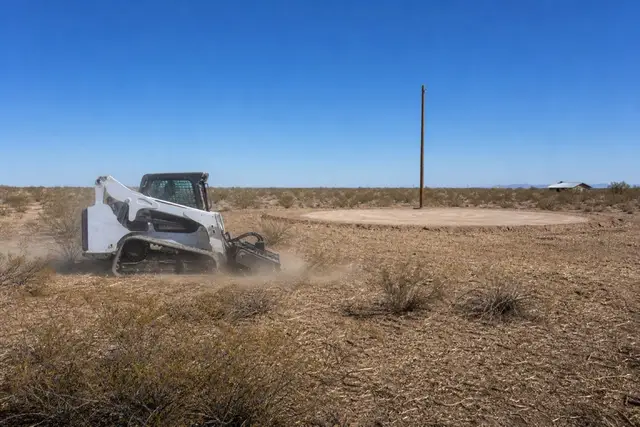

White Tank Clearing Pros puts Circle City property owners on the phone with a local land clearing contractor for mulching, brush removal, and pad prep anywhere in the Circle City area.
Circle City is the far West Valley at its most elemental — an unincorporated scatter of parcels along Grand Avenue counted at 522 residents in 2020, where the horizon runs flat to the Hieroglyphic and Vulture ranges and the nearest anything is a drive. People buy here for exactly that: acreage, quiet, and the freedom of county land — and then discover that freedom includes personally arranging everything a subdivision would have provided, starting with usable ground.
The foundational jobs are the trade here. Well pads cleared and leveled for the drill rig, with turnaround room the rig operator will thank you for. Power-pole runs cleared along the parcel line for the utility's build. A first lane bladed from the county road, crowned to survive storms it will definitely meet. And the homesite or hookup envelope — for a build, a manufactured home set, or an RV pad — cleared, grubbed, and roughed level on ground that has never been anything but creosote.
Ongoing, Circle City parcels want the honest-desert maintenance rhythm: mulching passes that keep the interior open, tumbleweed mowed before it stacks against the Grand Avenue fence lines, and fence corridors kept walkable on ground where open-range rules make your wire your problem. It's straightforward machine work on cooperative flat ground — the complications here are logistical, not technical, and a contractor who works the corridor plans for them.
Wells, power, and pads: the utility sequence on raw ground
Off-grid-adjacent parcels succeed on sequencing. The well comes early — everything else needs its water — and the drill rig needs a cleared, level pad plus honest access before it will book you. The power run, where you're taking utility service, wants its corridor cleared to the utility's spec along the shortest defensible line. Then the envelope work makes sense, informed by where water and power actually landed. Soil homework front-loads well: the NRCS survey plus the UA Extension's caliche guide forecast the digging on both the trench and the septic questions.
All of it is disturbance in the county's eyes: pads, lanes, and trenched corridors count toward the dust-permit threshold the same as subdivision work. One permit, one water plan, one mobilization covering the whole first-improvement package is the economical shape of the job.
Big-sky ground and the wind that owns it
Circle City's defining physical fact is fetch — miles of open flat that let wind organize before it reaches your parcel. That shapes the work: cleared surfaces get left mulch-covered or crusted, never loose; tumbleweed management is a schedule, not an event, because the highway fence line will collect everyone's crop all season; and structures benefit from windbreak thinking, keeping the right vegetation as shelter rather than clearing by reflex. The NWS wind-hazard material reads differently when your nearest windbreak is a mountain range two townships over.
The reward for managing it well is the whole point of Circle City: a parcel where the lane holds, the pad drains, the fence is visible wire instead of a tumbleweed dam, and the desert between them is intact and yours. The Extension's rural-acreage resources are the right companion reading for owners doing most of their own upkeep between machine visits.