 White Tank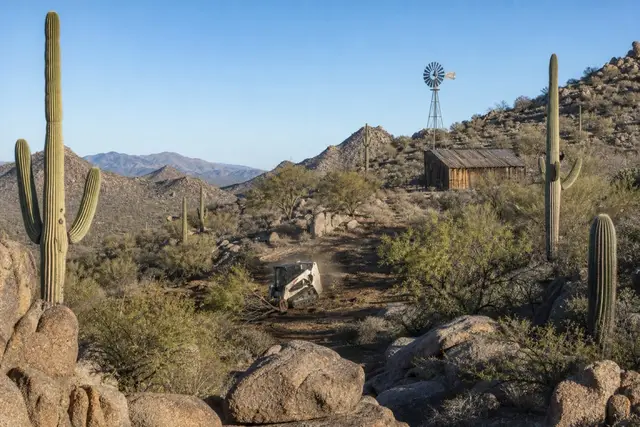
White Tank Clearing Pros puts Wickenburg property owners on the phone with a local land clearing contractor for mulching, brush removal, and pad prep anywhere in the Wickenburg area.
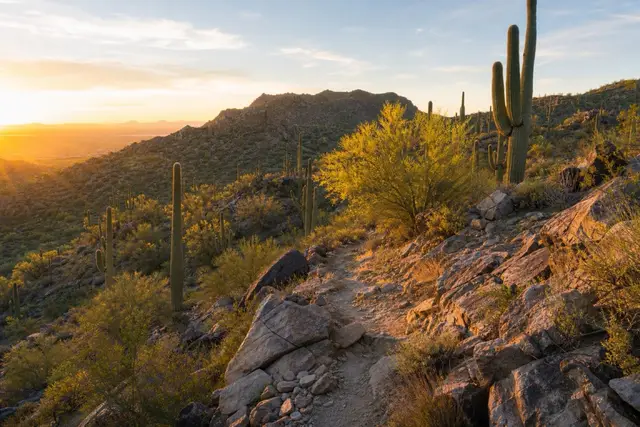
Wickenburg sits a thousand feet above Buckeye and a world apart in character — a genuine ranch town of 7,474 at the 2020 count, where dude ranches invented Arizona tourism, team roping fills the winter calendar, and the Hassayampa runs its brief above-ground stretch through town. The clearing trade follows the terrain: upland Sonoran hillsides of saguaro, ironwood, and jojoba over decomposed granite, cut by boulder fields and steeper grades than anything down on the Buckeye flats.
Hillside work is selective by necessity and by taste. Wickenburg properties are bought for their desert, so the job is almost never scorched-earth — it's thinning: cured grass and dead brush out, jojoba and catclaw pushed back from structures and lanes, sight lines opened for the horses and the views, with every saguaro flagged and the ironwoods — protected and essentially irreplaceable at their growth rates — treated as landscape anchors. Machines pick their lines around granite outcrops, and some slopes get hand crews because that's what the ground allows.
Down along the river corridor the enemy is familiar: tamarisk thickets crowding the cottonwood-willow reaches that make this stretch of the Hassayampa special. Root-first removal, native canopy preserved, banks respected — the same discipline the preserve downstream applies, scaled to private parcels and horse crossings.
Thinning upland desert without ruining it
The upland Sonoran mix around Wickenburg is older and slower than flatland scrub — an ironwood can predate the town, and the saguaro forest on a north-facing bajada took centuries to assemble. Thinning it well is subtraction, not clearance: fine fuels and dead wood out, healthy natives kept with room around them, the understory opened so a ground fire has nothing continuous to run on. The zone logic in the Firewise framework applies with extra force on slopes, where fire moves uphill fast and structures sit at the top.
The legal layer is thicker here too: saguaro and ironwood both sit in the state's most protected categories, and the native-plant-law framework — notice windows, salvage pathways — applies on ranch ground exactly as it does in a subdivision. Operators who work the Wickenburg country plan removals around the protected inventory from the first walk-through, which is why the good bids come with flagging tape already in the truck.
Granite, grades, and getting machines up there
Wickenburg's decomposed-granite slopes behave differently than valley soils: they shed water fast, gully where disturbed carelessly, and hide boulders that reprice an excavation in one clang. The Arizona Geological Survey's mapping of these basement-rock uplands is genuinely useful due diligence for hillside owners — it explains both the boulder fields and why two neighboring driveways cost wildly different amounts to cut.
Practical hillside clearing follows the ground's rules: tracked machines stay under their slope limits, work runs on contour to avoid creating gullies, disturbed surfaces get left rough and mulch-covered so the first storm doesn't rill them, and the steepest faces get hand tools rather than heroics. Storm cells build over this terrain early on summer afternoons — the Phoenix NWS coverage area includes Wickenburg's forecast — and a half-finished cut on a slope is the wrong place to meet one.